


The Ethics Collection
Dr David Nixon
THE ETHICS COLLECTION - The Institution as Hard Matter and Medicine After Nuremberg
The Institution as Hard-Matter:
Permeability, Hardening and Loss of Transiion Potential
What happens when institutions become stabilising interpretation that they begin losing sensitivity to change?
The Institution as Hard-Matter explores what happens when adaptive systems lose the capacity to learn, correct, and respond to reality. Rather than focusing on individual failures, it examines how people, professions, organisations, and institutions gradually harden over time, becoming less permeable to feedback, uncertainty, and new possibility. Through the concepts of adaptive coherence, truth, trust, observation, and hardening, the book offers a new way of understanding why systems sometimes drift away from the realities they were created to serve.
A framework for exploring how institutions preserve or lose transition potential, and why the future of any living system depends upon its capacity to remain open to correction, adaptation, and change.
Medicine After Nuremberg:
Purpose, Permeability , and the Dynamics of Ethical Systems
What happens when ethical systems lose the capacity to receive, interpret, and respond to reality?
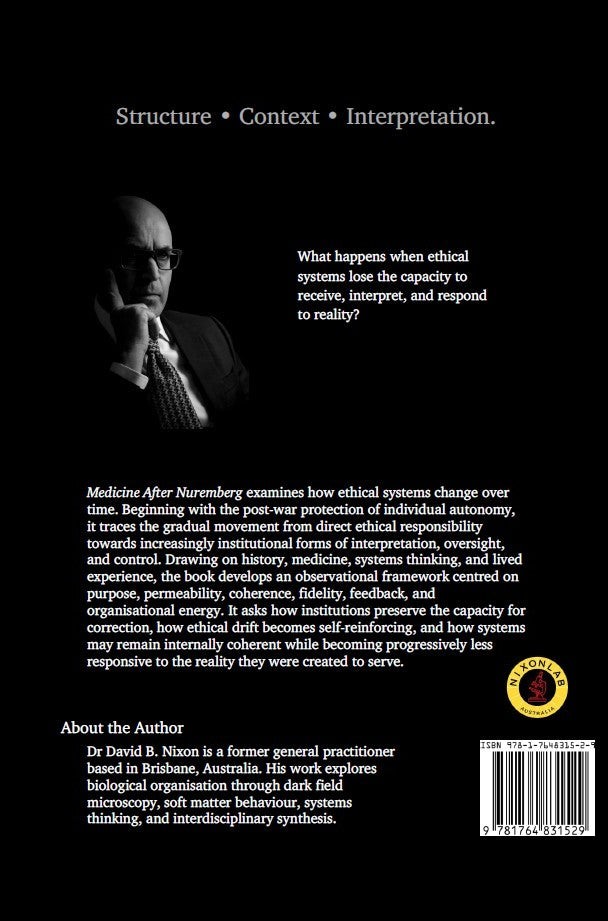
Medicine After Nuremberg examines how ethical systems change over time. Beginning with the post-war protection of individual autonomy, it traces the gradual movement from direct ethical responsibility towards increasingly institutional forms of interpretation, oversight, and control. Drawing on history, medicine, systems thinking, and lived experience, the book develops an observational framework centred on purpose, permeability, coherence, fidelity, feedback, and organisational energy. It asks how institutions preserve the capacity for correction, how ethical drift becomes self-reinforcing, and how systems may remain internally coherent while becoming progressively less responsive to the reality they were created to serve.
THE ETHICS COLLECTION - The Institution as Hard Matter and Medicine After Nuremberg
The Institution as Hard-Matter:
Permeability, Hardening and Loss of Transiion Potential
What happens when institutions become stabilising interpretation that they begin losing sensitivity to change?
The Institution as Hard-Matter explores what happens when adaptive systems lose the capacity to learn, correct, and respond to reality. Rather than focusing on individual failures, it examines how people, professions, organisations, and institutions gradually harden over time, becoming less permeable to feedback, uncertainty, and new possibility. Through the concepts of adaptive coherence, truth, trust, observation, and hardening, the book offers a new way of understanding why systems sometimes drift away from the realities they were created to serve.
A framework for exploring how institutions preserve or lose transition potential, and why the future of any living system depends upon its capacity to remain open to correction, adaptation, and change.
Medicine After Nuremberg:
Purpose, Permeability , and the Dynamics of Ethical Systems
What happens when ethical systems lose the capacity to receive, interpret, and respond to reality?
Medicine After Nuremberg examines how ethical systems change over time. Beginning with the post-war protection of individual autonomy, it traces the gradual movement from direct ethical responsibility towards increasingly institutional forms of interpretation, oversight, and control. Drawing on history, medicine, systems thinking, and lived experience, the book develops an observational framework centred on purpose, permeability, coherence, fidelity, feedback, and organisational energy. It asks how institutions preserve the capacity for correction, how ethical drift becomes self-reinforcing, and how systems may remain internally coherent while becoming progressively less responsive to the reality they were created to serve.
Couldn't load pickup availability
Share


You Also Viewed

The Ethics Collection